

9 Best Cat Brushes for Long-Haired Cats That Actually Work
Last Updated: November 1, 2026
Quick Summary
The best cat brush for long-haired cats depends on coat density and tangle risk, not breed. A slicker brush handles everyday maintenance, while an undercoat rake reaches the dense inner layer during heavy shedding. Pair a primary tool with a wide-toothed comb to catch tangles early.
- Long-haired cats have an outer coat and a dense undercoat, so one brush rarely covers both.
- Use an undercoat rake during seasonal shedding, followed by a slicker brush.
- Check the armpits, behind the ears, and the base of the tail with a comb twice weekly.
- Never cut a mat close to the skin with scissors; cat skin folds easily and can be cut.
- Keep grooming sessions to two or three minutes and stop when the cat shows stress.
Table of Contents
- Why Long-Haired Cats Need a Different Brush
- Brush Types and What Each One Does
- Matching a Brush to Your Cat's Coat Length and Problem
- Choosing a Brush for Matted Cat Fur
- How to Groom a Long-Haired Cat Without Stressing Them
- Building a Long-Haired Cat Grooming Routine
- Start Brushing Your Cat Gently This Week
- Frequently Asked Questions
Why Long-Haired Cats Need a Different Brush
Long-haired cats shed more, tangle faster, and need tools built for dense coats. A short-haired brush often skims the top coat and leaves the undercoat matted underneath. Finding the best cat brush for long-haired cats starts with understanding why their coats behave differently.
A long coat has two layers. The outer coat is the longer, visible hair, while the undercoat is the soft, dense layer close to the skin. Loose hair collects in that undercoat, and if it isn't removed, it knots into mats.
Long-haired cats also tend to hold dirt and dander in their coats. Regular brushing lifts those particles out before they settle into the fur.
Brush Types and What Each One Does
Each brush type solves a different problem, so the right choice depends on what your cat's coat needs most. The main categories are slicker brushes, combs, undercoat rakes, and deshedding tools.
- Slicker brushes: Fine, closely set wire pins that remove loose hair and surface debris. They work well for everyday maintenance on long coats.
- Wide-toothed combs: Metal combs with spaced teeth that check for tangles and work through the coat without pulling.
- Fine-toothed combs: Used after brushing to catch small knots, flea dirt, and the last of the loose undercoat.
- Undercoat rakes: Wide-set teeth that reach the dense inner layer during heavy shedding periods.
- Deshedding tools: Designed to pull out loose undercoat efficiently, typically used during seasonal shedding.
Soft bristle brushes suit cats with sensitive skin or those new to grooming, though they remove less loose hair than wire tools.
Matching a Brush to Your Cat's Coat Length and Problem
Most long-haired cats do not need one "best" brush, they need a small kit matched to coat density, mat tendency, and sensitivity. Instead of buying by breed name, evaluate three things: how dense the undercoat feels when you part the fur, where tangles form first, and how your cat reacts to pin contact.
Use this decision guide:
- Dense, cottony undercoat that sheds heavily: Start with an undercoat rake with wide-set, rounded teeth to reach the inner layer, then follow with a slicker brush to lift surface hair. A rake alone can leave the top coat rough; a slicker alone skims the surface. The pair covers both layers.
- Fine, silky coat that tangles at friction points: A slicker brush with flexible pins plus a wide-toothed metal comb. The slicker smooths and removes loose hair; the comb is your tangle detector. Run the comb through the armpits, behind the ears, and at the base of the tail after brushing, if it snags, you found a forming knot before it became a mat.
- Thick coat with established mats or a history of matting: A dematting comb with blunt-tipped teeth for small knots, and a slicker for maintenance once the coat is clear. Avoid starting with a deshedding blade on a matted coat; it can catch and pull.
- Sensitive skin or a cat new to grooming: A soft bristle brush or a slicker with rounded pin tips. These remove less undercoat, so pair them with a comb check rather than expecting full deshedding.
- Senior or arthritic cat: A slicker with a flexible head and light pressure, plus a comb for spot checks. Avoid stiff rakes that require downward pressure.
A practical test before you commit: part the coat along the spine and look at the skin. If loose grey fluff sits close to the skin, you need an undercoat tool. If the coat looks smooth but snags a comb at friction points, you need detangling. If the skin is visible and the coat is thin, a gentle slicker or bristle is enough.
The table below summarises which brush suits each coat type and problem, based on the guidance above.
| Coat or problem | Primary tool | Finishing tool |
|---|---|---|
| Dense undercoat that sheds heavily | Undercoat rake | Slicker brush |
| Fine, silky coat that tangles at friction points | Slicker brush | Wide-toothed metal comb |
| Thick coat with established mats | Dematting comb | Slicker brush |
| Sensitive skin or new to grooming | Soft bristle brush | Comb check |
| Senior or arthritic cat | Slicker with flexible head | Comb for spot checks |
Choosing a Brush for Matted Cat Fur
Brushes prevent mats; they rarely remove a tight one. The practical skill is knowing the difference between a loose tangle you can work out and a mat that needs a professional.
First, grade the tangle. Part the fur and look at the skin. A small, loose tangle that moves freely is a detangling job. A dense, felted pad that is tight to the skin, especially in the armpits, groin, behind the ears, or at the tail base, is a mat.
A repeatable detangling routine:
- Stabilize the skin. Place one hand flat against the cat's body just below the tangle so you feel any pull before the cat does. Work in short sessions and stop before the cat tenses.
- Separate the edges first. Use your fingers or a wide-toothed comb to tease the outer edge of the tangle apart, working from the tip toward the skin in small increments. Do not start at the skin and pull outward.
- Switch to a dematting comb for small knots. A comb with blunt-tipped teeth can slice through a loose knot when used parallel to the skin with light pressure. Keep the comb flat and let the teeth do the work.
- Check with a comb after every pass. If the comb still snags, the knot is not fully separated, go back to finger separation rather than pulling harder.
- Stop at the skin line. If the mat is tight to the skin and cannot be separated safely, stop. A trimmer with a guarded blade can remove a tight mat, but only if you are confident; otherwise book a groomer. For a trimmer and clipper kit that handles cutting out tangles brushes cannot remove, look at the options available.
Prevention is the higher-leverage habit. Mats form at high-friction points: armpits, behind the ears, the base of the tail, the belly, and between the hind legs. Check those five areas with a comb twice a week.
Electric Cat Steam Brush – 3-In-1 Pet Grooming Comb with Water Spray for Cats →

For owners who prefer a powered option, a cordless grooming trimmer can be used with care on a mat that cannot be separated by hand. Keep the blade parallel to the skin.
How to Groom a Long-Haired Cat Without Stressing Them
Most cats accept grooming when it is short, calm, and predictable. Pressure matters as much as tool choice. Brush gently, in the direction of hair growth, and use short strokes rather than long, hard passes.
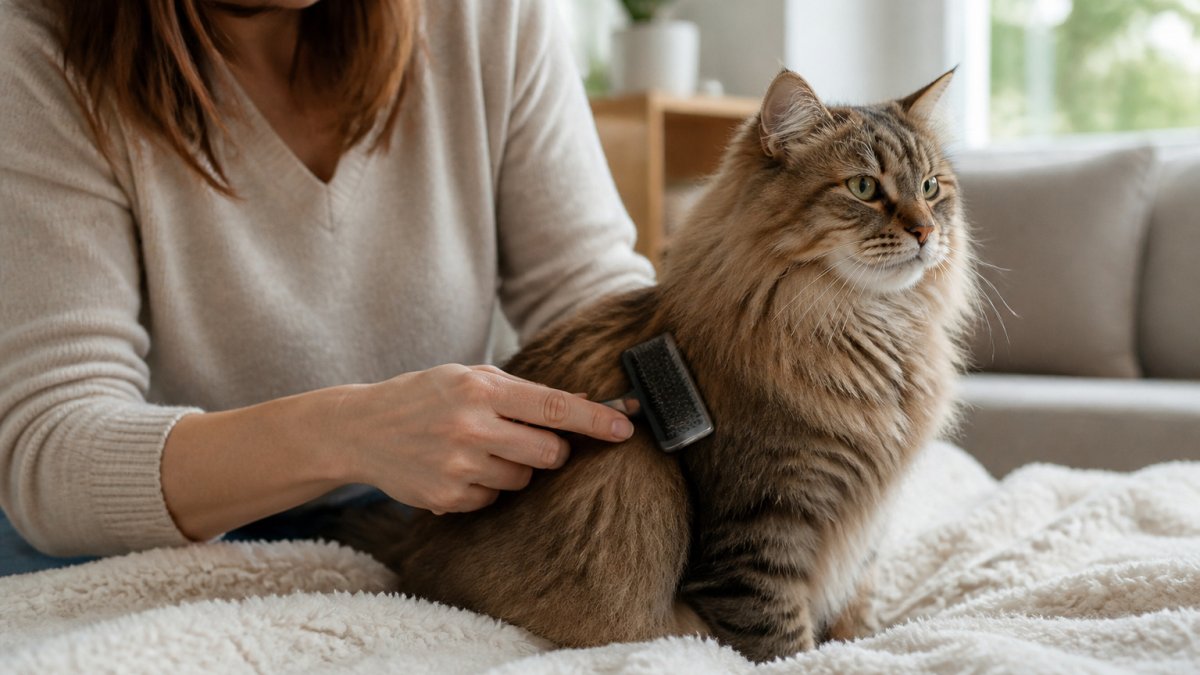
Begin in a quiet room where the cat feels safe. Offer a treat before and after each session. Start with two or three minutes, then stop while the cat is still relaxed. If you are looking for gentle grooming tools suited to sensitive skin, this guide compares your options. Short, frequent sessions build tolerance faster than one long, forced session.
!A calm long-haired cat sitting on a soft blanket while its owner gently brushes its flank with a soft slicker brush in a bright living room
Reading Your Cat's Comfort and Stress Signals
Watch the cat's body language throughout the session. Relaxed cats often blink slowly, purr, or lean into the brush. Stress usually shows up as flattened ears, a twitching or lashing tail, a tense body, or attempts to leave.
If you see these signs, pause and let the cat walk away. Return later with a shorter session. Forcing a cat to finish a grooming session almost always makes the next one harder. Keep the brush clean and the pressure light, especially along the belly, under the legs, and behind the ears, where skin is thin.
Building a Long-Haired Cat Grooming Routine
Consistency matters more than intensity. A brief daily session prevents the buildup that leads to mats and heavy shedding. Many owners find a routine works best when it is tied to an existing habit, such as after a meal or during a favorite evening show.
A practical weekly pattern:
- Daily: Two to three minutes with a slicker brush or soft bristle brush.
- Twice weekly: Check the coat with a wide-toothed comb, focusing on the armpits, behind the ears, and the base of the tail.
- During seasonal shedding: Add an undercoat rake or deshedding tool for one or two sessions per week.
- Monthly: Clean the brush by removing hair from the pins or teeth, and check for worn bristles.
Brush maintenance is part of good grooming. Clogged brushes spread dirt back into the coat, so clean them after every session.
Start Brushing Your Cat Gently This Week
Pick one tool that matches your cat's coat, set aside two or three calm minutes each day, and watch how your cat responds. Adjust the tool or the pressure based on what you see. The best cat brush for long-haired cats is the one your cat tolerates and that you will use consistently.
If you are unsure which tool fits your cat, browse the grooming tools at North Shore Pets, where our team can help you match the right brush to your cat's coat and temperament.
Frequently Asked Questions
What brush should I use to groom a long-haired cat?
Most long-haired cats do well with a combination of a wide-toothed metal comb and a slicker brush. The slicker brush lifts loose surface hair and dirt, while the comb reaches down to the undercoat and checks for tangles close to the skin. Use the slicker for the bulk of the coat and the comb to finish, working section by section. Choose a brush with rounded or capped pin tips so it does not scratch the skin. If your cat has a dense undercoat, a deshedding tool can help remove loose hair before the main brushing session.
How often should you brush a long-haired cat?
Brush a long-haired cat at least once a day, or every other day as a minimum. Daily brushing prevents tangles from forming and keeps shedding under control, which matters most during seasonal coat changes in spring and autumn. Short, frequent sessions of five to ten minutes are easier on the cat than one long session. If you notice mats forming behind the ears, under the legs or on the belly, increase the frequency in those areas. Consistency matters more than session length, so keep brushing at a predictable time each day.
What is the best brush for a cat with mats?
For existing mats, a dematting comb used carefully to split the mat rather than pull it can help. Always start at the outer edge of the mat and work inward, holding the base of the mat with your fingers to protect the skin. Avoid cutting mats with scissors close to the skin, as it is easy to cut the cat. For large or tight mats, or if your cat seems distressed, ask a veterinarian or professional groomer for help. Prevention with daily brushing is far easier than removing mats later.
How do you brush a long-haired cat without hurting them?
Use light pressure and let the brush glide through the coat rather than pressing into the skin. Support the coat with your free hand, brushing a small section at a time and working from the head toward the tail. Pay extra attention to sensitive areas like the belly, armpits and behind the ears, and stop if your cat flattens its ears, swishes its tail or tries to move away. Offering a treat during and after brushing helps your cat associate grooming with something pleasant. Stop before your cat gets upset, and try again later if needed.
