

Best Organic Pet Grooming Essentials for 2026
Table of Contents
- What Makes Pet Grooming Essentials Truly Organic
- Organic Dog Shampoo: Gentle Cleansing Without the Nasties
- Non-Toxic Pet Grooming Tools That Earn Their Drawer Space
- Cruelty-Free Dog Grooming Products: What the Labels Actually Mean
- The Best Cat Brush for Long-Haired Cats (and Why Coat Type Matters)
- Building Your Complete Organic Grooming Kit by Task
- Choosing the Best Organic Pet Grooming Essentials: Price, Safety, and Value
- Frequently Asked Questions
Last Updated: October 16, 2026
What Makes Pet Grooming Essentials Truly Organic
The global pet grooming products market was estimated at USD 15.6 billion in 2025 and is projected to reach USD 24.8 billion by 2033, according to Grand View Research's pet grooming products market report.

So here's the uncomfortable truth: organic pet grooming is a claim, not a guarantee. Grooming matters because it's an essential health-maintenance activity tied to the welfare of companion animals, and grooming-related problems can carry serious consequences (Grooming-Related Concerns Among Companion Animals).
The best organic pet grooming essentials are the ones you'll actually use, on a pet who tolerates them, with ingredients you can trace. Below, we break down what to buy by task and how to read a label.
Organic Dog Shampoo: Gentle Cleansing Without the Nasties
The best organic dog shampoo cleans gently without stripping the coat's natural oils or irritating sensitive skin.
Start with the ingredient list, not the front label. A shampoo worth buying names its surfactants (the cleansing agents), its preservatives, and its fragrance source.
Cleansers to look for: coconut-derived surfactants such as coco glucoside, decyl glucoside, and sodium cocoyl isethionate.
Ingredients to treat with caution:
- Tea tree oil (Melaleuca alternifolia): toxic to dogs and especially cats if ingested. A dog licking its coat after a tea tree shampoo can ingest enough to cause drooling, vomiting, or worse. Cats lack the liver enzymes to metabolize it and can react to skin contact alone.
- Essential oils generally: peppermint, eucalyptus, citrus, wintergreen, and cinnamon are common in "natural" pet products and are not automatically safe. Cats are particularly sensitive because they groom constantly and their livers process these compounds poorly.
- "Fragrance" as a single word: this can hide dozens of undisclosed compounds, some of which are irritants. Prefer products that list the fragrance source (e.g., "lavender essential oil" or "fragrance from natural botanicals").
- Preservatives: some natural products avoid parabens but substitute methylisothiazolinone (MI) or methylchloroisothiazolinone (MCI), which are common contact allergens. Phenoxyethanol and sodium benzoate are generally considered lower-risk alternatives.
How to verify an organic claim:
- Look for a named certifier such as USDA Organic, ECOCERT, or COSMOS. "Made with organic ingredients" is weaker than "certified organic" and usually means a small percentage of the formula.
- Check whether certification applies to the finished product or only one ingredient. A bottle can say "contains organic aloe" while the rest of the formula is conventional.
- Read the full ingredient list on the brand's website. If it isn't published, that's a signal.
Dilution and rinsing: most pet shampoos are concentrated.
Non-Toxic Pet Grooming Tools That Earn Their Drawer Space
Non-toxic pet grooming tools are made from materials that won't irritate skin, shed into the coat, or leach chemicals when wet, which matters because tools are used on broken skin, near eyes and ears, and often while wet.
Materials to prefer:
- Stainless steel for clipper blades, combs, and nail trimmers. It's durable, doesn't harbor bacteria the way porous materials can, and can be disinfected.
- Medical-grade silicone for brush bristles, paw cleaners, and grooming gloves. It's non-porous, flexible, and doesn't absorb oils or odors.
- Bamboo or FSC-certified wood for brush handles, provided the finish is a plant-based oil or wax rather than a polyurethane lacquer that can chip.
- Natural rubber for curry combs and massage brushes. It grips coat without static and is biodegradable, though it degrades faster than silicone.
Materials to question:
- Cheap plastics with strong chemical smells: may be off-gassing plasticizers. Air it out; if the smell persists, return it.
- Metal combs with sharp-cut teeth: run a finger along the teeth; if it catches, it will scratch skin.
- Bristles with glued-in tufts: glue can fail after washing, and loose bristles become a choking hazard for pets that chew.
- Painted or varnished handles: chips can flake into the coat. Unfinished or oil-finished handles are safer for pets that mouth their tools.
The real test is whether you'll use it. The biggest complaint we hear is simple: people buy grooming tools that end up sitting in a drawer.
How to compare tools consistently:
| Criterion | What to check | Why it matters |
|---|---|---|
| Material | Stainless steel, medical-grade silicone, natural rubber, unfinished wood | Avoids skin irritation and ingestion risk from coatings or loose parts |
| Noise level | Under 60 dB for electric tools | Quieter tools reduce stress for nervous pets |
| Cleanability | Dishwasher-safe or wipe-down surfaces | Residue and bacteria build up on porous or hard-to-clean tools |
| Coat match | Bristle type and spacing matched to coat length and density | Wrong tools tug, cut topcoat, or miss undercoat |
| Replaceable parts | Blades, bristle heads, or batteries can be replaced | Extends life and reduces waste |
| End-of-life | Recyclable metal, compostable wood, or take-back program | Reduces landfill waste from broken tools |
Task-by-task tool picks:
- Brushing: a soft-bristle brush or comb matched to coat type. Long-haired cats need wider-spaced teeth and rounded tips; short-coated dogs do well with rubber curry brushes.
- Bathing: a handheld sprayer or pitcher for thorough rinsing, plus a non-slip tub mat.
- Nail care: stainless steel clippers or a grinder, plus styptic powder for nicks. Grinders are quieter but require shorter, more frequent sessions.
- Ear care: a species-appropriate cleanser and soft pads. Never use cotton swabs inside the ear canal.
- Paw care: a paw cleaner with soft silicone bristles for post-walk mud, salt, and sand.
- Coat care: a conditioner for dry or tangled coats, applied and rinsed per label.
- Flea and tick: a spray or comb suited to your pet's size and species. Never use a dog flea product on a cat; permethrin is highly toxic to cats (pubmed.ncbi.nlm.nih.gov).
Our 4 in 1 Electric Pet Grooming Kit (North Shore Pets grooming kit) is built around that idea.

Waste and disposal: metal blades and combs can often be recycled with scrap metal; silicone and rubber parts usually go to landfill unless a brand offers take-back. Wooden handles finished with plant oil can be composted if the metal or bristle head is removed. Buying fewer, better tools is the most reliable way to reduce grooming waste.
Cruelty-Free Dog Grooming Products: What the Labels Actually Mean
Cruelty-free dog grooming products are made without animal testing, but the term isn't legally standardized, so you have to verify it yourself. Without a recognized certification, "cruelty-free" and "not tested on animals" are self-declared.
4 in 1 Electric Pet Grooming Kit - Hair Trimmer, Clippers, Nail Grinder →
So how do you check? Look for a named certification body on the packaging, a policy statement on the brand's site, and consistency across the whole product line. A genuinely committed brand applies the same standard to every item, not just the one with the badge:
- A specific certification name, not a vague leaf icon
- A published animal-testing policy
- The same standard applied across the full range
- Clear contact details so you can ask directly
If a label can't survive those four checks, treat the claim as marketing until proven otherwise.
The Best Cat Brush for Long-Haired Cats (and Why Coat Type Matters)
The best cat brush for long-haired cats is one with soft, rounded bristles that lifts loose fur and reaches the undercoat without scratching skin.
A brush that works beautifully on a short-coated dog can tug and irritate a long-haired cat. The wrong tool doesn't just fail to help, it teaches your cat to hate grooming, a hard habit to undo.
Our Electric Cat Steam Brush is designed for exactly this problem.

Building Your Complete Organic Grooming Kit by Task
A complete organic grooming kit covers five tasks: brushing, bathing, nail care, ear care, and paw cleaning. Build it by task rather than by brand, and you'll end up with fewer tools you actually use.
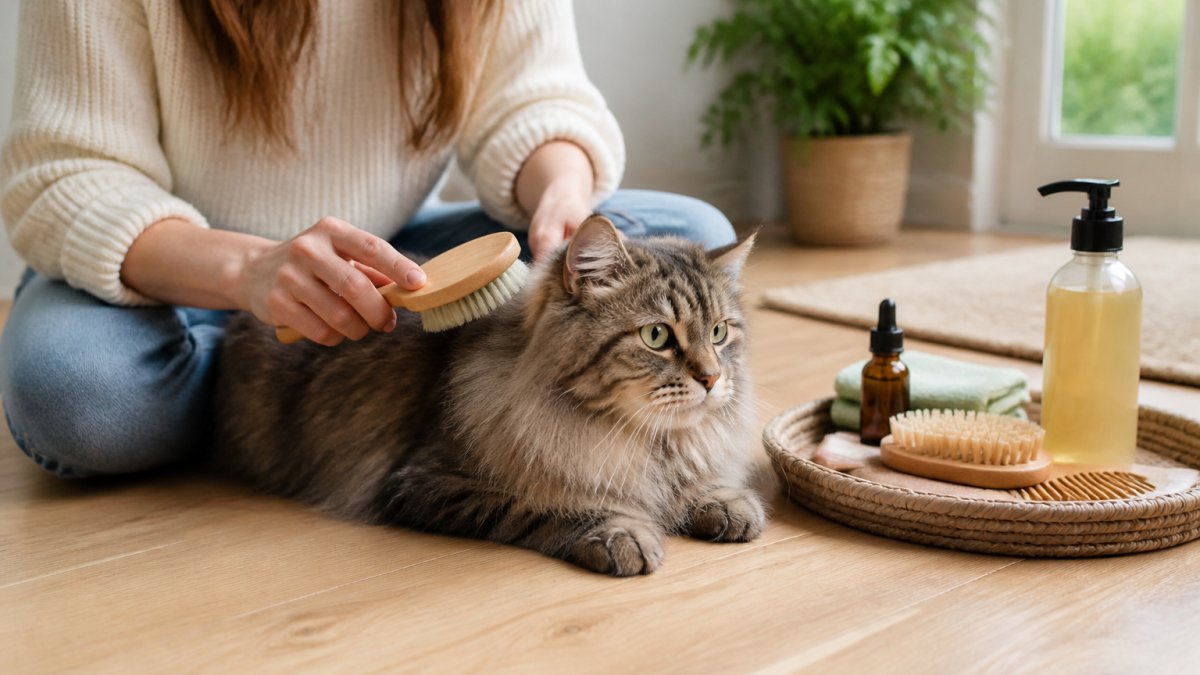
Here's the checklist we'd hand a new pet owner:
- Brushing: a soft-bristle brush or comb matched to coat type
- Bathing: a gentle, well-rinsed pet shampoo
- Nail care: clippers or a grinder, plus styptic powder for nicks
- Ear care: a species-appropriate cleanser and soft pads
- Paw care: a paw cleaner for post-walk mud, salt, and sand
- Coat care: a conditioner for dry or tangled coats
- Flea and tick: a spray suited to your pet's size and species
Our Dog Paw Cleaner fills the paw-care slot neatly. It uses soft, medical-grade silicone bristles to remove dirt, mud, salt, and sand, comes in small and large sizes, and cleans with a simple twist. At $22.00, it's an item people find incredibly useful.
Choosing the Best Organic Pet Grooming Essentials: Price, Safety, and Value
Choosing the best organic pet grooming essentials comes down to three filters: price, safety, and whether the product suits your specific pet.
On price, our three picks sit between $7.99 and $22.00, and each replaces a category of tool rather than a single item.
| Product | Price | Best For | Key Feature |
|---|---|---|---|
| Electric Cat Steam Brush | $7.99 | Long-haired cats and dogs | 3-in-1 comb with water spray |
| 4 in 1 Electric Grooming Kit | $21.99 | Cats and dogs needing trims and nail care | Trimmer, clippers, and nail grinder in one |
| Dog Paw Cleaner | $22.00 | Dogs after walks and outdoor play | Medical-grade silicone bristles |
On safety, the rule is species and exposure route.
And on suitability, be honest about your pet. A nervous dog won't tolerate a loud trimmer no matter how good it is.
The real challenge with organic pet grooming isn't finding products.
Frequently Asked Questions
How can I tell whether a pet grooming product is truly organic?
Look past the front label. A genuinely organic pet grooming product lists its ingredients clearly, names the certifying body if one is claimed, and avoids vague phrases like 'natural blend.' The research for this guide found that many product pages describe ingredients and positioning without providing certification details or comparative testing, so treat 'organic' as a claim to verify rather than a guarantee. Check the ingredient list, look for named plant extracts such as aloe vera or chamomile, and contact the seller if certification is unclear.
Are natural and organic grooming products safe for cats and dogs?
Natural ingredients are not automatically safe for every species. Cats and dogs differ in how they metabolize certain plant compounds and essential oils, so a product marketed for dogs may not suit a cat. Always rinse thoroughly after bathing, test a small area first, and ask your vet before using a new product on a pet with sensitive skin or existing health issues.
Which grooming tools are essential for long-haired cats?
Long-haired cats need a brush that reaches the undercoat without scratching skin. The Electric Cat Steam Brush from North Shore Pets ($7.99) uses soft bristles and rounded tips, works on long-haired and short-haired cats, and combines loose-fur removal with a water spray. Pair it with a nail grinder or trimmer for claw care, and brush several times a week to prevent mats. Coat type matters more than breed: the longer and denser the coat, the more often you need to work through it.
Can I make organic pet grooming products at home?
You can mix simple rinses using ingredients like vinegar, lemon, or baking soda, and these appear in many DIY grooming guides. The limitation is control. If your pet has sensitive skin or a diagnosed condition, a formulated organic dog shampoo with a clear ingredient list is often a better choice. Use DIY options for occasional freshening, not as a replacement for proper cleansing.
How often should I bathe my pet with an organic dog shampoo?
Most dogs do well with a bath every four to eight weeks, though coat type, activity level, and skin condition change that. Dogs with sensitive skin or skin irritation may need a gentler schedule and a soothing formula with ingredients like aloe vera or chamomile. Always rinse thoroughly, since leftover shampoo residue causes more irritation than the wash itself. Between baths, use a brush and biodegradable wipes to keep the coat clean and reduce shedding.